Force-Torque Sensor Integration for Contact-Rich Manipulation
Force sensing enables robots to recover from contact failures that vision alone cannot fix.
Force-torque sensor integration for contact-rich manipulation comes down to two separate problems that get treated as one: getting a reliable force signal onto the robot, and making sure the policy controlling that robot actually uses the signal once it arrives. Tasks like insertion and surface wiping depend on a robot sensing and regulating the forces it applies as it moves. Vision cannot supply this. A camera can tell a robot where a peg sits relative to a hole, but it cannot tell the robot how hard it is pressing, how much resistance the part is returning, or whether the gripper has begun to slip against an object's surface. These are mechanical quantities that announce themselves at the point of contact, and a robot without a way to measure them is, at that moment, blind in the dimension that matters most. This is part of why human-like forceful manipulation has stayed an unsolved problem in robotics: the collisions, balance corrections, and resistance cues that a human hand processes through proprioception have no equivalent channel in a vision-only robotic system.
This consequence appears most sharply not on a robot's first attempt at a task but on its second. A vision-only policy's success rate on novel objects drops sharply, from a first attempt down to just 13.3 percent on a second attempt, FACTR 2 reports (Oh, Liu, Tao et al., CMU/Waseda, 2025). Force-attending policies, by contrast, maintain consistent success rates across both attempts. The gap between those two numbers is the gap between a robot that can recover from a failed contact and one that cannot, and it is the clearest demonstration available of what force feedback actually buys a manipulation system.
How a Wrist-Mounted 6-Axis F/T Sensor Works
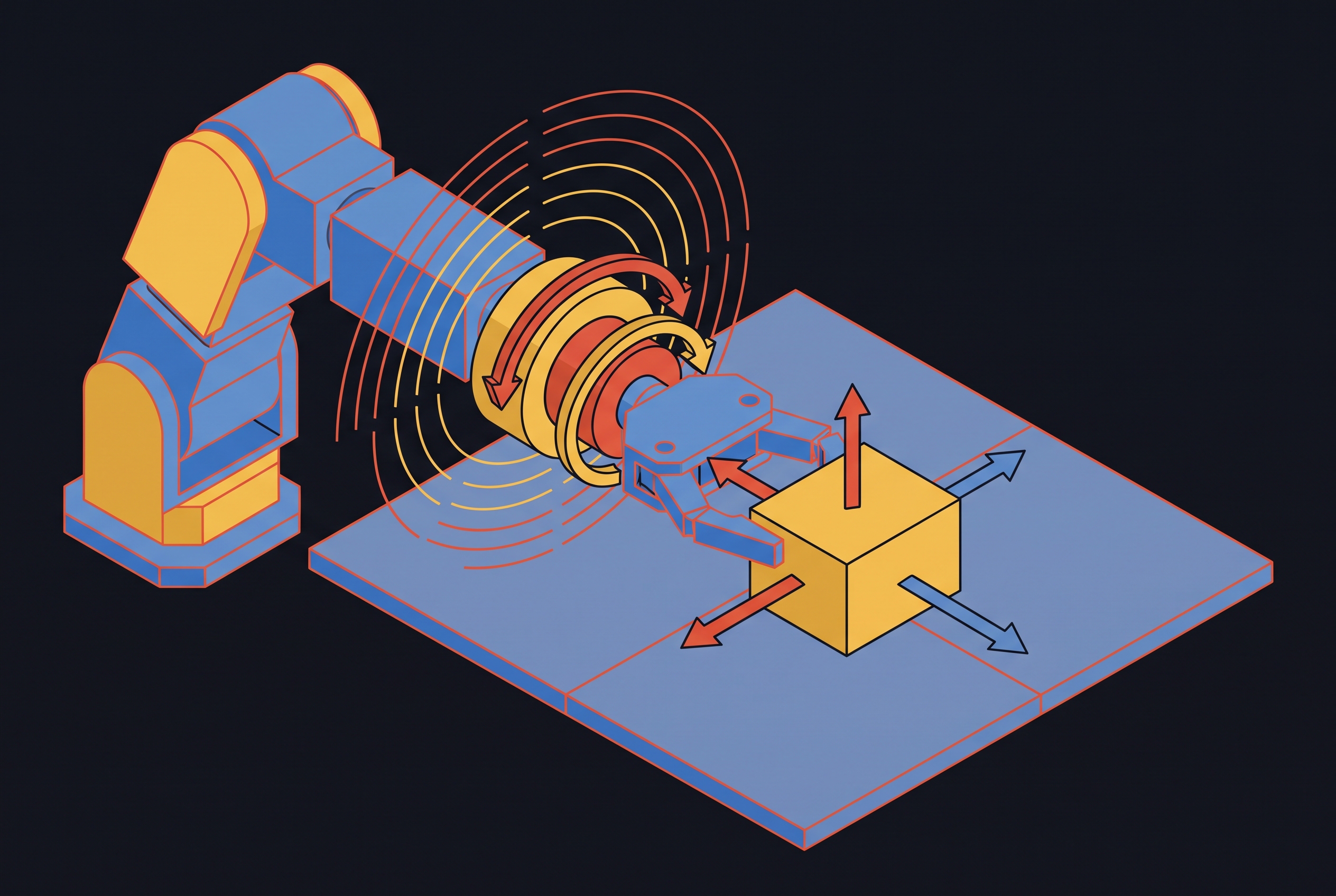
The standard hardware answer to this problem is a 6-axis force/torque sensor mounted between the robot's wrist and its end-effector. This arrangement is the reference configuration against which nearly every alternative gets measured, and it underwrites a long list of industrial applications, including contact-based inspection, assembly, sanding, deburring, and polishing.
Conventional units in this category are typically piezoresistive sensors built on precision-machined structures carrying multiple strain gauges, and they deliver high measurement accuracy. That accuracy comes with real costs: these sensors are bulky, mechanically delicate, and expensive to buy and maintain. The expense is not a minor line item. Retrofitting a low-cost robot arm with a commercial end-effector F/T sensor can cost more than the arm itself, a disparity FACTR 2 notes directly, and one that falls hardest on small labs and consumer-robotics teams working outside the largest research budgets. That asymmetry sets up the challenge of making force sensing accessible to labs and teams without large budgets, which the next section addresses.
The hardware access problem: cost, fragility, and the platforms left without sensors
The combination of high cost, bulky form factor, and vulnerability to drift and overload damage has effectively restricted large-scale, force-aware policy learning to well-funded labs working with expensive platforms such as Franka, Flexiv, or KUKA arms. Teams without access to that tier of hardware have historically had no practical way to collect the force data their policies would need. The problem compounds for dexterous, multi-finger hands: sensorizing every finger with industrial-grade force sensors is not merely expensive but economically untenable at current prices, which has kept sensor coverage out of reach for most multi-finger platforms.
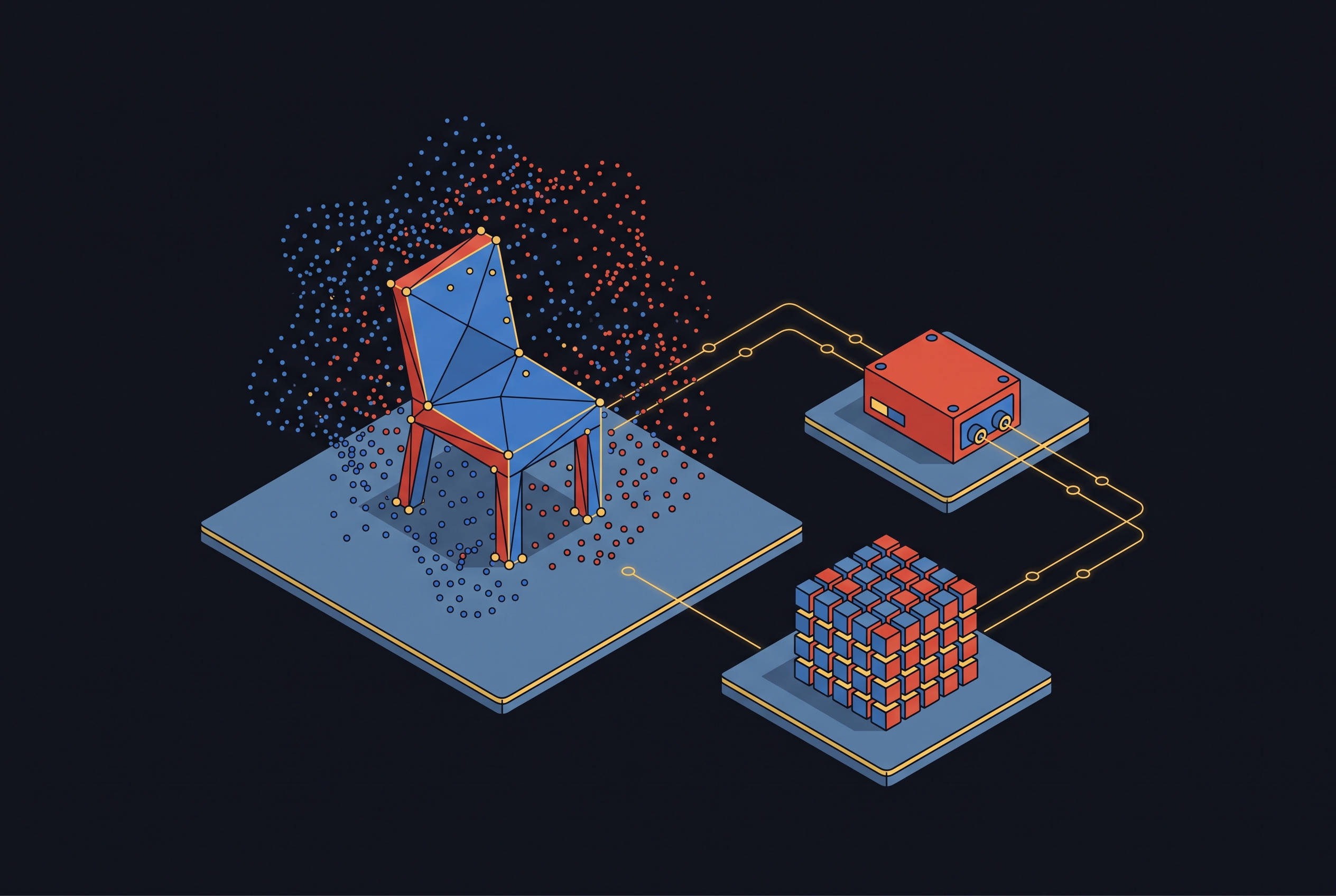
Two recent hardware developments illustrate what closing this gap can look like. CoinFT, from Choi et al. at Stanford's Cutkosky lab (2025), is a capacitive 6-axis F/T sensor built to the size of a US quarter dollar and weighing 2 grams, with a material cost under $10. It is constructed from a stack of two rigid printed circuit boards carrying comb-shaped electrodes, connected by an array of silicone rubber pillars. In testing, it achieves a root-mean-squared force error of 0.16 N and a moment error of 1.08 mNm, and its silicone-based construction tolerates overload events that typically damage metal-based sensors. The same design lineage out of Stanford has been described for surgical instruments, drone-contact sensing, and multi-fingered hands, specifically for applications where existing sensors are either too costly or too fragile to deploy at scale.
A second development, published in Nature Communications in July 2025, takes a different physical approach: a torque-angle-pressure tactile sensor that reads magnetic flux density gradients. It achieves bidirectional, ultrasensitive measurement, on the order of 0.1 degrees angular resolution and 0.4 newton-millimeters of torque resolution, with linearity of R² = 0.99 across a wide range of plus or minus 241.6 newton-millimeters, all through a single readout channel. That combination of sensitivity and range is what allows it to support ultraprecise placement tasks in unstructured environments. Neither sensor is presented here as superior to the other; they represent different engineering paths toward the same goal, which is putting force and torque measurement within reach of platforms that could never have justified the cost of a conventional industrial F/T sensor.
Sensorless estimation as a practical alternative for platforms that cannot carry dedicated hardware
A separate and increasingly credible line of research argues that dedicated force-torque hardware is not actually necessary for most contact-rich tasks, and that joint current readings or observer-based estimates can substitute at a fraction of the deployment cost, without the mechanical integration headaches that come with adding a physical sensor to an arm or hand.
FACTR 2's own contribution, Neural External Torque Estimation (NEXT), is the clearest statement of this position. NEXT is a data-driven method that estimates external joint torques using only 10 minutes of free-space, contact-free trajectories, followed by a brief training period. The resulting estimates closely track measurements from dedicated joint-torque sensors on high-end arms, and the same method enables force-feedback teleoperation on low-cost arms, including the AgileX Piper, YAM, and Nero, with no additional sensing hardware installed at all.
Other groups have extended the same logic to different robot morphologies and tasks. FWBC-VLA (Zhang, Ma et al., 2026) introduces HSR-Force, a sensorless residual-torque estimator built for wheeled-legged robots, which infers contact strength and how that strength changes over time directly from proprioceptive signals, then encodes those estimates as tokens fed into a vision-language-action decoder. On whiteboard-wiping and door-opening tasks, this sensorless approach achieved higher stage-wise success rates than baseline methods that used real F/T sensors. A separate 2026 project on zero-shot sim-to-real dexterous grasping eliminates torque sensors from multi-finger hands entirely, using a current-to-torque calibration that maps motor current directly to joint torque, combined with tactile simulation and actuator dynamics modeling; the authors describe it as the first demonstration of controllable grasping on a multi-finger hand trained entirely in simulation and transferred zero-shot to hardware.
The objection to this entire approach deserves to be stated directly rather than waved away. Estimation accuracy degrades under high contact forces and during rapid mode switching, when a system transitions quickly between free motion and contact. A deeper methodological concern follows from how these sensorless estimators are trained: when a privileged, sensorized system's behavior supplies the training target, the resulting sensorless estimate may end up correlating with contact state rather than accurately measuring force itself. That distinction matters because it leaves open whether a given policy's gains come from genuine force-awareness or from something closer to contact-state detection dressed up as force measurement. Peer reviewers raised exactly this concern about FWBC-VLA's load-bearing definition in its compensation training. None of this invalidates sensorless estimation as a practical tool for platforms that cannot carry dedicated hardware. A practitioner choosing between a physical sensor and an estimated signal is making a real tradeoff, not a cosmetic one, and the choice should be made with that tradeoff in view.
Why getting force signals onto the robot is necessary but not sufficient: the policy neglect problem
Solving the hardware side of this problem, whether through a physical sensor or a sensorless estimator, does not guarantee that a learned policy will use the resulting force signal. Naively concatenating force data onto a policy's observation vector during training routinely produces policies that neglect the force input. The transformer architecture underneath most of these policies learns the visual stream instead, because vision carries far richer raw dimensionality, and the force channel gets effectively ignored even when it is technically present in training data. That means a practitioner who installs a perfect force-torque sensor and simply appends its output to a standard observation vector can see no improvement at all in the resulting policy's behavior. The bottleneck sits in the training pipeline.
The same pattern appears in tactile sensing, a closely related modality. CAAT (Jiang, Huang et al., 2026) shows that directly concatenating tactile observation tokens with visual tokens forces the underlying model to infer both when tactile information is relevant and how to integrate it with everything else the policy is seeing, an inference problem reflected in CAAT's own experiments, where moving away from direct visuo-tactile fusion yields an 18.0 percentage-point improvement in average success rate in simulation. The underlying cause is structural. Contact events occupy only a small fraction of any given trajectory, so the comparatively rare, informative tactile signal gets overwhelmed by the much larger volume of non-contact observations surrounding it.
Visible Touch, from Dogan, Sun, Xu et al. at UCLA, identifies the same bottleneck from a different research direction. Their work locates the core difficulty in integrating contact sensing into visuomotor policies not in the contact information itself but in how that information gets delivered to the policy. That framing matters because it reorients the whole problem. By this point in the field's development many platforms already have access to force or tactile data. What matters is whether the delivery mechanism gives the policy any reasonable path to using that data, and naive concatenation, the field has found repeatedly, does not.
Contact-phase awareness as the design principle that makes force inputs usable
Several independent research groups, approaching the problem of policy neglect from different starting points, have converged on the same underlying fix: visual information is most useful before contact occurs, and force or tactile information is most useful during contact, and a policy that is not given this structure as a prior has to discover it from data alone, which demands far more demonstrations and frequently fails regardless of how much data it gets.
FACTR 2's own answer, Force-Informed Re-Sampling Training (FIRST), uses NEXT's external torque estimates to segment every demonstration into free-space, pre-contact, and contact phases, then up-samples the pre-contact and contact segments during behavior cloning, concentrating the policy's learning on exactly the moments when force is most diagnostic. Across five long-horizon tasks, FIRST substantially outperforms prior force-aware policies in task progress. The earlier paper (Liu, Li, Shaw, Tao, Salakhutdinov, Pathak, RSS 2025) arrives at a related result through a different mechanism: a training curriculum that corrupts visual input with decreasing intensity over the course of training, which forces the policy's attention toward the force channel and prevents the transformer from over-fitting to vision. That curriculum improves success rate on unseen objects by an average of 40.0 percent across four contact-rich tasks: box lifting, prehensile pivoting, fruit pick-and-place, and dough rolling.
CAAT builds the same principle directly into its attention mechanism. It introduces contact-aware attention scaling that explicitly emphasizes visual tokens before contact and tactile tokens during contact, paired with dynamic tactile masking that suppresses static background tokens by comparing the current tactile reading against a non-contact reference. Integrating CAAT with ACT substantially improves average success rate over both direct visuo-tactile fusion and gated fusion in simulation, and in real-world experiments on a visuo-tactile UMI platform, CAAT achieves a strong average success rate across ACT, Diffusion Policy, and π₀, outperforming the strongest baseline by a meaningful margin. Visible Touch solves the same problem by a route that avoids architecture entirely: it renders contact measurements as a spatial overlay directly inside the policy's RGB image input, so contact arrives as pixels in the same visual frame the policy already attends to, with no separate processing pathway required. On LIBERO, this improves BC-Transformer success by a substantial margin on average in the 2-view setting, and both miniVLA on LIBERO and π₀.₅ on four real-world contact-rich tasks gain considerably on average. FWBC-VLA takes yet another route, encoding sensorless contact estimates as tokens injected into the VLA action decoder while feeding proprioceptive state, Jacobian-derived body-frame force estimates, and contact state jointly into a compensation generator, with that compensation branch producing the largest incremental gain across real-world tasks.
Curriculum corruption, phase-aware resampling, attention scaling, image-space overlay, and token injection are five different engineering mechanisms, built by separate teams working on separate platforms. What they share is a single governing idea: a policy needs to be told, structurally, when to look and when to feel. That convergence, arrived at independently rather than by coordination, is strong evidence that contact-phase conditioning is not one technique among many but the design principle the problem of policy neglect actually calls for.
Where the architecture debate is now: how force should enter the policy's computation
Accepting that force should enter a policy through contact-phase-aware conditioning settles one question and opens another. Researchers now largely agree that force and tactile information need structured, phase-aware delivery to be useful. They have not agreed on where in a policy's computation that delivery should happen: whether force should be fused into the action head, woven into the token stream, routed through a dedicated mixture-of-experts module, or layered on as an image-space overlay the way Visible Touch does it.
ForceVLA (Yu et al., 2025, NeurIPS) answers with a force-aware mixture-of-experts architecture, routing force information through dedicated expert modules rather than a shared representation. CRAFT (2026, arXiv:2602.12532) takes a different position, fine-tuning an existing VLA backbone's weights with a force-aware curriculum rather than training a new architecture from scratch. In testing, π₀-base combined with CRAFT consistently attains the highest success rate across most tasks against available baselines, including FACTR, which supports the broader claim that force-aware fine-tuning of an already-pretrained VLA can outperform building a force-aware policy from the ground up. TA-VLA (Zhang et al., 2025, CoRL) takes a more exploratory position, mapping the architectural design space without declaring any single configuration the winner.
Visible Touch's image-overlay method sidesteps this entire architectural debate. Because contact information arrives as pixels, no change to the underlying policy architecture is required, which makes the method compatible with any pretrained image-conditioned VLA. VISTA-Policy (Chen, Dong, Huang et al., Tsinghua/SUSTech) pushes further in the direction of avoiding dedicated sensing hardware altogether. It uses the Visual Deformation Field, a three-dimensional displacement representation of a passive compliant gripper observed by an external camera, as a form of visuo-physical feedback that substitutes for tactile or force sensors, and this approach outperforms both pure-vision and tactile baselines in testing. The field has not settled on a single answer to where force belongs in a policy's computation, and the range of approaches currently under active development, from mixture-of-experts routing to backbone fine-tuning to image-space overlays that need no architectural change at all, indicates that this remains a live design decision rather than a solved problem waiting to be adopted.
Sources
- FACTR 2: Learning External Force Sensing for Commodity Robot Arms Improves Policy Learning
Provided the core empirical results on FACTR 2, including the 13.3 percent second-attempt success rate, the NEXT sensorless torque estimator, the FIRST phase-aware resampling method, and the 40 percent improvement figure across contact-rich tasks.
- FWBC-VLA: Force-Aware Whole-Body Compensation for Contact-Rich Loco-Manipulation
Provided details on FWBC-VLA's HSR-Force sensorless residual-torque estimator for wheeled-legged robots and its token-injection approach to VLA action decoding.
- CAAT: Contact-Aware Attention Scaling and Tactile Masking for Data-Efficient Contact-Rich Manipulation
Provided the CAAT architecture's contact-aware attention scaling and tactile masking mechanism, and the 18 percentage-point improvement from moving away from direct visuo-tactile fusion.
- Visible Touch: Rendering Contact for Visuomotor Policies
Provided the Visible Touch method of rendering contact measurements as a spatial overlay in RGB image input, and results on LIBERO and real-world tasks.
- VISTA: Visually Inferred Spatial ConTact Attention for Contact-Rich Manipulation
Provided details on VISTA-Policy's Visual Deformation Field approach as a substitute for dedicated force or tactile sensors.
- Using capacitive sensing to create robust, low-cost force-torque sensors for real-world robotics
Provided details on the CoinFT capacitive sensor's comb-shaped electrode construction, measurement accuracy figures, and the applications context for the Stanford Cutkosky lab design.
- CoinFT: A Coin-Sized, Capacitive 6-Axis Force Torque Sensor for Robotic Applications
Provided specific technical details on the CoinFT sensor including the $10 material cost, silicone rubber pillar construction, and RMS force and moment error figures.
- Touching with torque enables human-level robotic dexterity - PMC
Provided details on the torque-angle-pressure magnetic tactile sensor achieving 0.1-degree angular resolution, 0.4 Nm torque resolution, and R²=0.99 linearity across a wide measurement range.